Synctera
Synctera
Synctera
Role
Lead Product Designer
Timeline
Oct 2023 - March 2024
Where I redesigned fraud operations, help operatives reduce wrongful transaction blocks by 20% and aligning banks and fintechs on a unified platform.
Where I redesigned fraud operations, help operatives reduce wrongful transaction blocks by 20% and aligning banks and fintechs on a unified platform.
About Synctera
Synctera provides the infrastructure that enables banks and fintechs to launch and operate regulated financial products. Within this ecosystem, fraud operations teams review alerts, investigate high-risk activity, and make decisions that directly impact customers, partner banks, and regulatory posture.
As the platform scaled, fraud operations became increasingly complex. Analysts managed growing alert volume across KYC, transaction monitoring, and compliance workflows while coordinating with multiple external partners. Decisions were time-sensitive, auditable, and difficult to reverse.
The challenge wasn’t simply moving faster. It was maintaining confidence that decisions reflected the current reality of an investigation, especially when work was blocked, incomplete, or dependent on others.
Synctera provides the infrastructure that enables banks and fintechs to launch and operate regulated financial products. Within this ecosystem, fraud operations teams review alerts, investigate high-risk activity, and make decisions that directly impact customers, partner banks, and regulatory posture.
As the platform scaled, fraud operations became increasingly complex. Analysts managed growing alert volume across KYC, transaction monitoring, and compliance workflows while coordinating with multiple external partners. Decisions were time-sensitive, auditable, and difficult to reverse.
The challenge wasn’t simply moving faster. It was maintaining confidence that decisions reflected the current reality of an investigation, especially when work was blocked, incomplete, or dependent on others.
What was Broken.
Despite multiple tools and alerts, analysts lacked a reliable way to understand case state, priority, and ownership, leading to premature closure, blocked work, and invisible risk.
Despite multiple tools and alerts, analysts lacked a reliable way to understand case state, priority, and ownership, leading to premature closure, blocked work, and invisible risk.
Case state didn’t reflect reality
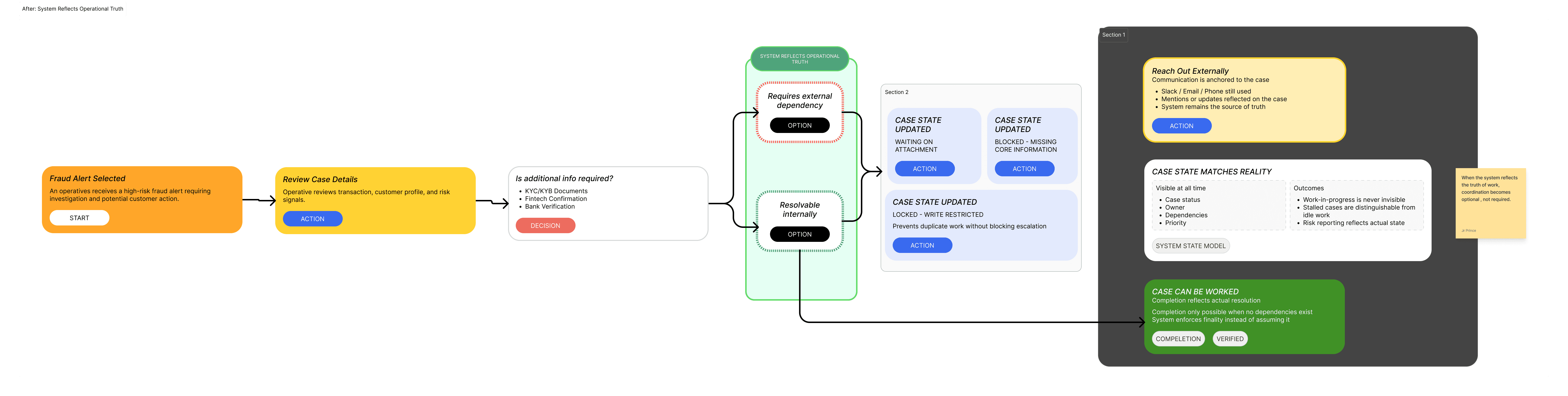
Cases had no clear sense of where they were in the investigation lifecycle. In several workflows, the only way to move a case forward was to mark it as complete even when work was still ongoing. In-progress investigations could appear resolved, while stalled work became invisible.
Case state didn’t reflect reality
Cases had no clear sense of where they were in the investigation lifecycle. In several workflows, the only way to move a case forward was to mark it as complete even when work was still ongoing. In-progress investigations could appear resolved, while stalled work became invisible.
Ownership was unclear
There was no reliable signal showing who was actively working a case or whether progress was blocked. Multiple analysts could unknowingly work the same investigation, duplicating effort and creating conflicting decisions.
Ownership was unclear
There was no reliable signal showing who was actively working a case or whether progress was blocked. Multiple analysts could unknowingly work the same investigation, duplicating effort and creating conflicting decisions.
Progress moved outside the system
Blocked cases were resolved through Slack messages, E-mails, or phone calls. If documentation arrived via E-mail and wasn’t uploaded, cases stalled silently. None of this activity was reflected back into the system of record.
Progress moved outside the system
Blocked cases were resolved through Slack messages, E-mails, or phone calls. If documentation arrived via E-mail and wasn’t uploaded, cases stalled silently. None of this activity was reflected back into the system of record.
After
How I Changed the System
To address pain points and known issues, I reframed fraud case management around a simple principle: The system must always reflect the current truth of work, even when progress is blocked.
To address pain points and known issues, I reframed fraud case management around a simple principle: The system must always reflect the current truth of work, even when progress is blocked.
Consolidate Fragmented Tooling
Creating a single source of truth without replacing core tools
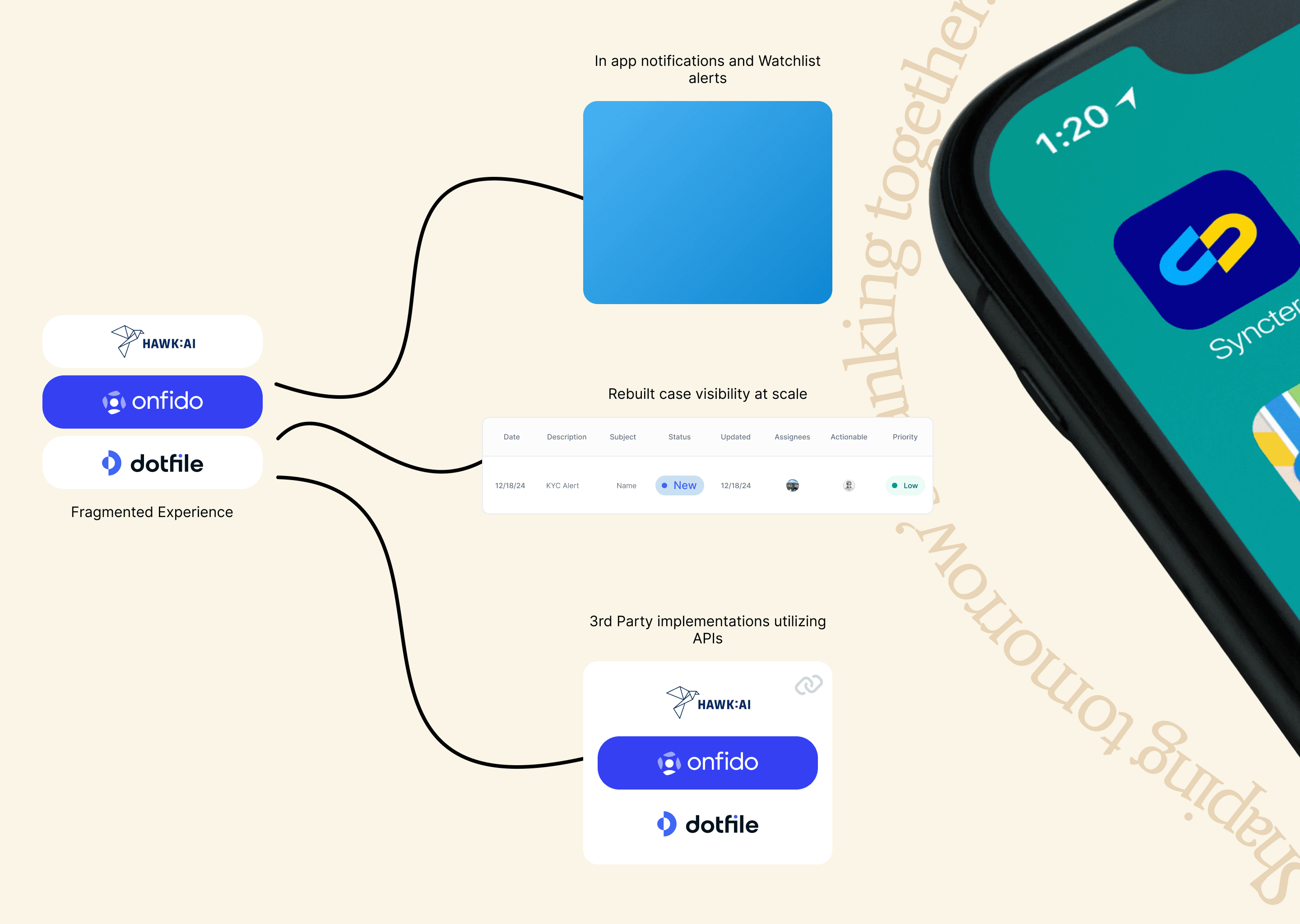
Fraud investigations used to force analysts to jump between products like Hawk AI, Onfido, and Dotfile, piecing together identity checks, risk signals, and decisions across multiple tools. I mapped how those systems were actually being used and redesigned the workflow into a single internal experience that kept the investigation anchored in one place.
Instead of replacing existing tools, I created a simple in-context way for analysts to open third-party systems when needed, then return to the case to capture findings and add notes without losing progress. This reduced back-and-forth, removed manual reconciliation, and gave teams a clearer, more reliable view of what was happening in each case.
Fraud investigations used to force analysts to jump between products like Hawk AI, Onfido, and Dotfile, piecing together identity checks, risk signals, and decisions across multiple tools. I mapped how those systems were actually being used and redesigned the workflow into a single internal experience that kept the investigation anchored in one place.
Instead of replacing existing tools, I created a simple in-context way for analysts to open third-party systems when needed, then return to the case to capture findings and add notes without losing progress. This reduced back-and-forth, removed manual reconciliation, and gave teams a clearer, more reliable view of what was happening in each case.
Reduced Coordination Noise
Analysts needed timely updates without constant interruption. Notifications were designed to activate only when intent was explicit, keeping focus high while preserving collaboration.
Analysts needed timely updates without constant interruption. Rather than broadcasting notifications, I designed alerts to activate only when intent was explicit, such as mentions or active watching.
For teams that relied heavily on Slack, case notifications were connected directly to shared channels, anchoring coordination back to the system of record while preserving focus.
Analysts needed timely updates without constant interruption. Rather than broadcasting notifications, I designed alerts to activate only when intent was explicit, such as mentions or active watching.
For teams that relied heavily on Slack, case notifications were connected directly to shared channels, anchoring coordination back to the system of record while preserving focus.
Rebuilt Case Visibility at Scale
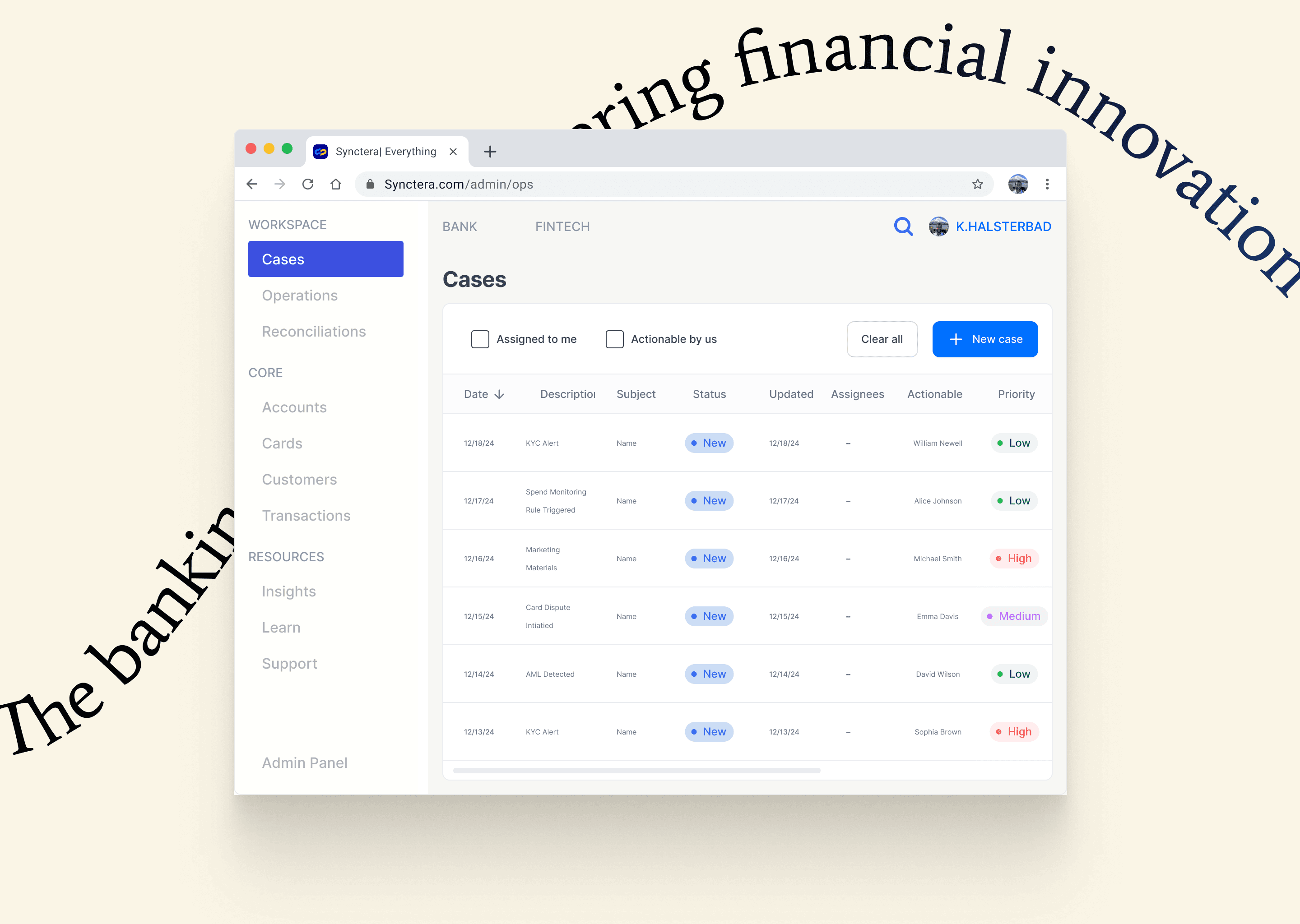
The dashboard was designed to make priority, ownership, and workload immediately legible without requiring analysts to infer urgency from tables or tribal knowledge.
Before the redesign, urgency was inferred socially. Cases older than a few days were assumed to be urgent, and workload lived in analysts’ heads rather than the system.
The redesigned dashboard encoded priority directly into the interface. Cases were ranked using priority signals and manager assignment, allowing analysts to focus on the highest-risk work without manual sorting.
At a glance, the dashboard answered three questions:
What needs attention now?
Who is working on what?
Where is work getting stuck?
This replaced tribal knowledge with shared situational awareness.
Before the redesign, urgency was inferred socially. Cases older than a few days were assumed to be urgent, and workload lived in analysts’ heads rather than the system.
The redesigned dashboard encoded priority directly into the interface. Cases were ranked using priority signals and manager assignment, allowing analysts to focus on the highest-risk work without manual sorting.
At a glance, the dashboard answered three questions:
What needs attention now?
Who is working on what?
Where is work getting stuck?
This replaced tribal knowledge with shared situational awareness.
Impact & Validation
The system must always reflect the current truth of work, even when progress is blocked.
Impact was validated by tracking how cases moved through the system before and after launch, focusing on time spent in active investigation and reduction in stalled or prematurely closed cases. Partnering closely with Operations and conducting post-launch analyst interviews confirmed that improvements reflected real workflow change even as overall case volume increased.
Impact was validated by tracking how cases moved through the system before and after launch, focusing on time spent in active investigation and reduction in stalled or prematurely closed cases. Partnering closely with Operations and conducting post-launch analyst interviews confirmed that improvements reflected real workflow change even as overall case volume increased.
What I’d Protect Going Forward
The dashboard should not be treated as a reporting surface it functioned as a workload stabilizer for fraud operations.
If another designer were to take over this system, I would strongly caution against making casual changes to the dashboard. It wasn’t just a place to view tasks; it became the primary mechanism through which analysts understood their workload, progress, and capacity.
By making assignment, priority, and active work visible at both the individual and team level, the dashboard helped analysts plan their day, set expectations, and avoid the constant feeling of falling behind. This visibility didn’t just improve throughput, it reduced burnout by replacing uncertainty with clarity.
At a team level, shared visibility allowed work to be redistributed before pressure became unsustainable. Analysts could see when others were overloaded, managers could intervene earlier, and the team operated with a clearer sense of collective responsibility.
Because of this, the dashboard carried more weight than a typical UI surface. It shaped behavior, morale, and trust. Any future changes should be approached with care, validated against real operational behavior, and evaluated not just for efficiency gains, but for their impact on workload balance and team health.
If another designer were to take over this system, I would strongly caution against making casual changes to the dashboard. It wasn’t just a place to view tasks; it became the primary mechanism through which analysts understood their workload, progress, and capacity.
By making assignment, priority, and active work visible at both the individual and team level, the dashboard helped analysts plan their day, set expectations, and avoid the constant feeling of falling behind. This visibility didn’t just improve throughput, it reduced burnout by replacing uncertainty with clarity.
At a team level, shared visibility allowed work to be redistributed before pressure became unsustainable. Analysts could see when others were overloaded, managers could intervene earlier, and the team operated with a clearer sense of collective responsibility.
Because of this, the dashboard carried more weight than a typical UI surface. It shaped behavior, morale, and trust. Any future changes should be approached with care, validated against real operational behavior, and evaluated not just for efficiency gains, but for their impact on workload balance and team health.